

What Is a Chassis, and Why Is It a Security Blind Spot?
What is a chassis?
A chassis is the load-bearing frame of a vehicle — the platform on which the body, engine, and wheels are mounted. In everyday usage, "chassis" often refers to everything you see when a car is lifted on a hoist: the frame rails, axle assemblies, exhaust line, fuel tank, suspension arms, and the many voids and cavities between them. The U.S. Department of Transportation defines the chassis in commercial vehicles as the frame plus running gear — the structure that remains once the cargo body is removed.
That structural complexity is exactly what makes the undercarriage attractive to bad actors. A modern chassis contains dozens of factory-fitted boxes, channels, and recessed areas. To an untrained eye — or a guard with a mirror and a flashlight — an attached object is nearly indistinguishable from an original component.
Why the chassis is the top hiding spot for threats
Security agencies have consistently identified the vehicle undercarriage as the primary concealment location for:
1.Improvised explosive devices (IEDs) and vehicle-borne IEDs, where the device is magnetically or mechanically attached to the frame
2.Contraband such as narcotics, weapons, and smuggled goods taped into chassis cavities
3.Tracking devices and covert surveillance hardware planted on a target's vehicle
4.Stowaways attempting to enter restricted zones or cross borders
Manual mirror inspections struggle against all four threat classes. They take several minutes per vehicle, depend on lighting, weather, and operator attention, and produce no verifiable record of what was checked. That is why facilities that take vehicle screening seriously have replaced the mirror with an underbody inspection scanner.
What Is an Underbody Inspection Scanner?
An underbody inspection scanner — also sold as an under-vehicle surveillance system (UVSS) or under-vehicle inspection system (UVIS) — is a security device that captures a complete, high-resolution image of a vehicle's underside as it passes over a scanning surface.
A typical scanner combines four building blocks:
1.Line-scan or area-scan cameras that build a seamless, distortion-corrected image of the chassis
2.LED or infrared supplementary lighting that keeps image quality consistent at night and in bad weather
3.Vehicle-detection sensors and speed-matching modules that synchronize the scan with vehicle movement, typically up to 30 km/h
4.ANPR (automatic number plate recognition) and review software that links each undercarriage image to a plate number, timestamp, and searchable database
Because the scan is automatic, a checkpoint can screen a vehicle in roughly one second without requiring it to stop, and store a searchable audit trail of every inspection. Leading systems such as Commport's CPUVIS platform report more than 10,000 installations across 45-plus countries, which signals how mainstream the technology has become at high-security gates.
How Fixed Under-Vehicle Scanners Work
A fixed under-vehicle scanner is permanently installed in the roadway, usually flush-mounted in a concrete pit at a gate lane. As each vehicle drives over the scanner at low speed, the embedded cameras capture the full undercarriage and pass the image to the control room.
Strengths of fixed scanners:
1.Throughput. Flush mounting means no ramp, so vehicles flow at natural gate speed — critical when a site processes hundreds or thousands of vehicles a day.
2.Durability. Industrial fixed units are typically rated IP68 and engineered for axle loads of 30 tons or more; Commport rates its fixed platform for vehicles up to 78 tons, comfortably covering loaded semi-trailers and airport fire trucks.
3.Integration. Fixed lanes usually connect to barriers, access control, and ANPR so the scan result can gate the barrier automatically.
4.Coverage. Fixed units commonly deliver a 180° field of view with no hidden angles.
Limitations: installation requires civil works (excavation, concrete, drainage), which means higher upfront cost, weeks of lead time, and a permanent footprint. Fixed scanners are also tied to one lane — they cannot follow the threat.
Best-fit sites for fixed scanners: international airports, seaports and customs, military bases, prisons and sally ports, border crossings, embassies, data centers, and power plants — in short, any permanent, high-traffic, high-consequence entry point.
How Portable Under-Vehicle Scanners Work
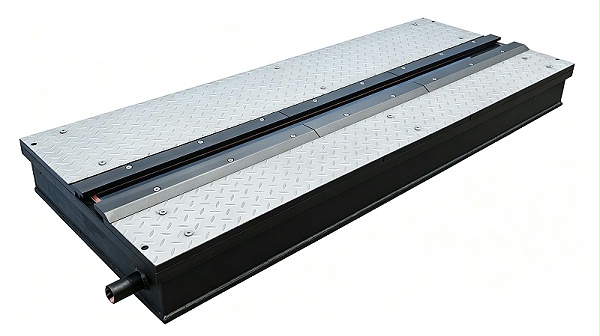
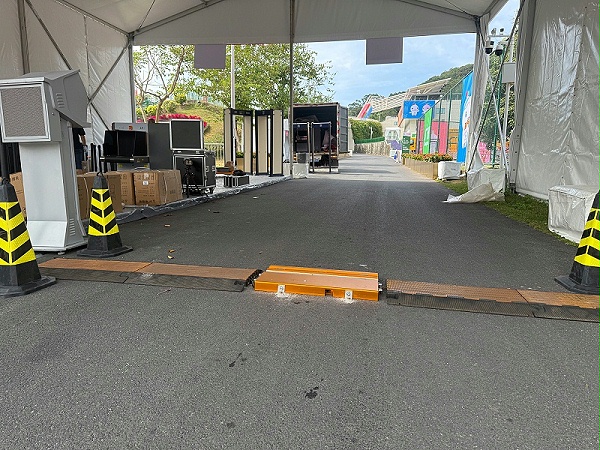
A portable under-vehicle scanner is a self-contained scanning ramp or mat that operators place on the road surface and connect to a ruggedized laptop or tablet. There is no excavation: two people can typically deploy a unit in under 15 minutes, and many modern units run on batteries for a full shift.
Strengths of portable scanners:
1.Rapid deployment. No civil works means a checkpoint can exist today and be gone tomorrow — ideal for events, VIP movements, and emergency response.
2.Multi-site coverage. One system can rotate across several gates or locations, which lowers the cost per protected site.
3.Lower entry cost. Mid-range portable units generally list between $2,500 and $10,000 depending on resolution and mobility features, versus roughly $17,000 to $20,000 for fixed installations (market pricing, 2025).
4.Flexibility for leased or heritage sites. Where drilling the driveway is prohibited or impractical, a surface-mounted ramp is the only viable option.
Limitations: the ramp creates a slight speed bump that can slow traffic; load ratings are lower (typically around 10 tons and IP66 weather protection, per Hikrobot's UVSS specifications); and the cable-connected layout needs protection from being driven over.
Best-fit sites for portable scanners: temporary checkpoints, stadiums and arenas, hotels hosting summits or VIP delegations, construction sites, corporate campuses, and rapid-response deployments by police or military units.
Market analysts at Persistence Market Research note that portable and mobile UVSS demand is growing at roughly a 7.4% CAGR as security needs become more dynamic — a sign that many organizations now deploy both: fixed systems at main gates and a portable unit for surge and special-event coverage.
Where Scanners Fit into Security Vehicle Search Procedures
A scanner is only as good as the security vehicle search procedures around it. Most professional screening operations — from airport SIDAs to military gate protocols — follow a similar sequence, and the underbody scan is one layer within it, not a replacement for the rest.
A standard vehicle search procedure looks like this:
1.Approach and identification. ANPR reads the plate; the officer matches the vehicle against an access list or watchlist.
2.Driver and credential check. ID verification and authorization happen in parallel with the scan.
3.Undercarriage scan. The vehicle rolls over the scanner at the posted speed; the system captures and stores the chassis image in about one second.
4.Review and comparison. The operator inspects the image — and, on return visits, compares it against the vehicle's previous scan to spot new or changed objects. AI-assisted systems flag anomalies automatically.
5.Compartment search (if warranted). Cab, cargo area, and trunk checks follow based on risk level and the scan result.
6.Decision and logging. Access is granted, denied, or escalated; the image, plate, timestamp, and decision are retained as an audit trail.
7.Secondary inspection. Vehicles with anomalies or changed undercarriages are diverted for a manual search.
Two procedure-design points matter when choosing fixed or portable:
1.Lane discipline. Fixed systems let you design a permanent, controlled lane with barriers and standoff distance. Portable deployments need cones, signage, and staffing to replicate that discipline.
2.Randomness. Because portable scanners can appear anywhere at any time, they add an unpredictability factor that fixed lanes cannot — a genuine deterrent for pre-planned attacks.
How to Choose: A 7-Question Checklist
Work through these questions before you specify a system:
1.Volume: Do you screen more than roughly 300–500 vehicles per day? If yes, lean fixed for throughput.
2.Duration: Will the site operate for more than three to five years? Long horizons justify civil works.
3.Property rights: Do you own the roadway? Leased or protected sites push you to portable.
4.Vehicle mix: Do loaded trucks or heavy vehicles cross the lane? Confirm axle-load rating — above 10 tons, fixed is usually required.
5.Integration: Must the scan gate a barrier or tie into access control? Fixed lanes integrate more deeply.
6.Threat profile: Is your risk continuous (fixed) or event-driven and mobile (portable)?
7.Budget shape: Can you absorb higher capex for lower lifetime cost (fixed), or do you need lower capex and flexibility now (portable)?
If your answers split — say, a permanent gate plus occasional off-site events — the hybrid answer is legitimate: a fixed unit at the main lane and one portable unit for surge capacity.
FAQ
What is the chassis of a vehicle?
The chassis is the vehicle's load-bearing frame — the structure supporting the body, powertrain, and wheels. In security contexts, "chassis inspection" means examining this underside structure for attached threats, hidden compartments, or tampering.
What does an underbody inspection scanner detect?
It detects attached or foreign objects on the undercarriage: explosives and IEDs, contraband, hidden compartments, tracking devices, and structural tampering. Modern AI-based systems compare each scan against the vehicle's previous images to flag changes automatically.
How accurate are under-vehicle scanners?
Modern line-scan systems capture full-width, distortion-corrected images at up to 180° field of view, revealing small objects that mirror inspections miss. Accuracy still depends on image resolution, lighting, scan speed discipline, and operator review — which is why audit trails matter.
Can a portable scanner handle trucks?
Most portable ramps are rated for around 10 tons, covering passenger cars, vans, and light trucks. Heavier commercial vehicles generally require a fixed, IP68-rated in-road system. Always verify the axle-load specification against your heaviest expected vehicle.
Is a fixed scanner always more secure than a portable one?
No. Core imaging performance is similar. Fixed systems win on durability, throughput, and integration; portable systems win on speed of deployment and unpredictability. Security outcome depends most on procedures and operator training.
How much does an under-vehicle scanning system cost?
As of 2025, mid-range portable units typically run $2,500–$10,000, while fixed installations commonly run $17,000–$20,000-plus once civil works are included. Pricing scales with camera resolution, AI features, and integration depth.
Conclusion: Match the Scanner to the Mission
Fixed and portable under-vehicle scanners solve the same problem — chassis visibility — in opposite ways. Fixed systems embed security into the roadway for permanent, high-volume, heavy-vehicle gates. Portable systems put chassis inspection wherever the risk appears, whenever it appears.
Choose fixed when throughput, durability, and deep integration drive your operation. Choose portable when flexibility, speed of deployment, and multi-site coverage matter most. And when your threat picture includes both, deploy both.
Ready to specify an under-vehicle scanning solution? Compare our fixed and portable scanner lines, or talk to our security engineering team about a deployment plan matched to your site's traffic, vehicles, and procedures.
Related: deploying at temporary sites? Read our guide to the portable under vehicle scanner (mobile UVSS) for events and temporary checkpoints.
Why Every Customs Checkpoint Needs an Under-Vehicle Scanning System: Rethinking Ports Security from the Ground Up.
AI-Empowered Under-Vehicle Inspection: How Intelligent Recognition Technology is Reshaping Security


