

Every government building, military installation, prison, embassy, airport, bank and critical industrial site shares one vulnerability: the vehicle that pulls up to its gate. In the seconds it takes an officer to wave a handheld mirror under a chassis, a vehicle-borne explosive, a concealed person or a deliberate ramming attack can already be inside the perimeter. This is why security checkpoint solutions have moved from manual inspection toward layered, automated screening lines that inspect the undercarriage, the cargo, the license plate and the people in a single controlled process. For security directors and procurement teams comparing vehicle screening solutions, the question is no longer whether to automate, but which configuration best fits the site, the traffic and the threat.
This guide explains the building blocks of modern vehicle checkpoint security, how they work together, and the criteria that separate a dependable system from an expensive display. It is written for buyers in the evaluation stage, whether you are designing a new entrance, upgrading an existing checkpoint, or preparing a tender specification. Seenboom, a manufacturer of under-vehicle scanning systems since 2000 and a contributor to the drafting of the national industry standard for under-vehicle security inspection, shares the field experience behind its equipment so you can compare options with confidence.
Below you will find no single-product pitch. The article compares the technology options honestly, points out where buyers overpay or under-specify, and shows what a genuinely complete security checkpoint solution should include. Where a claim is made about Seenboom equipment, the supporting product page or case study is linked so you can verify it directly.
The Checkpoint Challenge: Where Manual Screening Fails
Threats that arrive on wheels are not hypothetical. Security agencies such as the U.S. Cybersecurity and Infrastructure Security Agency publish hostile vehicle mitigation resources that recommend layered protection against vehicle ramming and vehicle-borne explosive attacks, and the same logic applies at every secure gate. A vehicle that cannot be inspected quickly is a risk that a site must manage manually, refuse, or remove with automation.
In practice, manual checkpoints fail in five predictable ways:
1. The undercarriage is a blind spot. A flashlight and mirror check is slow, uncomfortable and easy to shorten on a busy day. Explosives, weapons, contraband, tracking devices and even people can be fixed to the chassis, hidden behind fuel tanks, or tucked into spare-wheel wells where an officer cannot see clearly.
2. Security and throughput fight each other. Every extra minute of inspection lengthens the queue, and at peak times staffing pressure forces shortcuts. The shortcut, not the threat, becomes the weakest point.
3. Manual checks leave no evidence. Without an image of the undercarriage, a plate read, or a time stamp, an incident that happens hours later cannot be investigated or reconstructed.
4. Vehicle and people screening are separated. Drivers and passengers are checked somewhere other than their vehicle, leaving a gap that an entrance security system must close at a single control point.
5. Equipment is bought in isolation. A camera here and a barrier there rarely share data, so alarms cannot be linked to vehicle identity or to a central command picture.
None of these failures is solved by a single device. They are solved by a complete security checkpoint solution in which under-vehicle imaging, plate recognition, physical barriers and personnel screening operate as one interlocked process with a single record of every event.
Anatomy of a Complete Security Checkpoint Solution
A modern checkpoint is a short, controlled production line with four stages: detect the threat, identify the vehicle, stop it if required, and screen the people and cargo inside it. Each stage has a defined technology, and each must communicate with the others.
Under-Vehicle Scanning Systems: The Core of Vehicle Screening
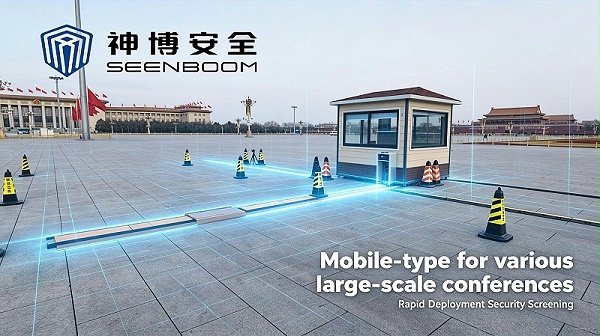
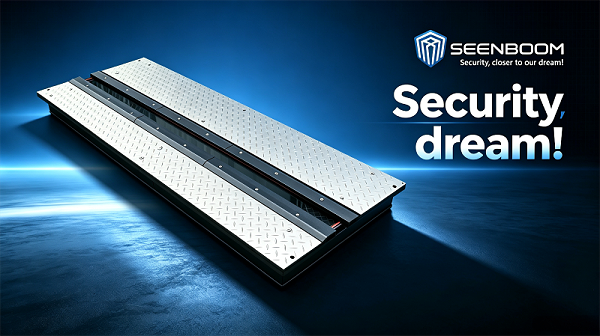
The under-vehicle scanning system, or UVSS, is the heart of any serious vehicle screening solution. Installed flush in the roadway in its fixed form, or supplied as a portable ramp in its mobile form, it photographs the complete undercarriage while the vehicle drives over at low speed. High-resolution line-scan and multi-lens cameras stitch an undistorted image of the whole chassis, and modern AI software automatically flags suspicious foreign objects, such as a package taped to the exhaust, an auxiliary fuel tank, or a person clinging to the frame.
Seenboom builds both architectures. A fixed under-vehicle scanning system suits permanent lanes, withstands vehicle loads up to 70 tons, carries an IP68 rating for outdoor installation, and integrates with lane signals and barriers. A mobile under-vehicle scanning system can be unpacked and running within minutes, which makes it the preferred vehicle screening solution for events, temporary checkpoints, and sites that cannot cut into the road surface. You can also browse the full range of under-vehicle scanners in the Seenboom product center.
Individual model pages go deeper, from the fixed Distortion-Free scanner for permanent lanes to the Cat's eye-L and AS-CDAJ-8002 portable scanners for rapid deployment.
A scan that cannot be stored is only half a system. Seenboom software archives every image, links it to the plate read and the lane, and supports both live alarm review and later forensic search. That is what turns a UVSS from an inspection tool into an evidence and audit system, which is exactly what regulators and insurers expect at high-security sites.
ANPR: Identifying Every Vehicle Before It Stops
Automatic number plate recognition cameras read the plate of every approaching vehicle and check it against trusted, denied and watch lists before the lane. ANPR does more than open a gate. It creates the identity that ties the UVSS image, the driver credential, the time stamp and the barrier event into one searchable record, so when an alarm is raised, the operator sees exactly which vehicle triggered it and can replay the scan immediately.
For vehicle checkpoint security, ANPR is the connective tissue of the lane. Confirm that the reader performs reliably in your lighting and weather conditions, including glare, rain and night operation, and that its output feeds the same platform as the under-vehicle scanner.
Vehicle Barriers: Making a Threat Stop at the Line
Detection without physical control leaves no way to act. Crash-rated vehicle barriers, such as hydraulic road blockers and security bollards, turn an alarm into a stopped vehicle. Road blockers span the full lane and are the standard choice for main entrances, while bollards protect pedestrian zones, secondary gates and perimeters where a clear view matters.
In an integrated checkpoint, the barrier interlocks with the screening result. It stays down until the plate, undercarriage and people checks are clear, then rises automatically, removing the manual decision point where most breaches occur. Test methods and design guidance for crash-rated barriers are collected in the vehicle incident prevention and mitigation security guide published by CISA. Seenboom supplies its road blockers and bollards as part of the same access control package as its scanning systems.
Choose the barrier class from a site risk assessment rather than from habit. The stopping requirement depends on the approach speed, the width of the opening, the weight of the largest likely vehicle and the standoff distance available, so the barrier that protects a pedestrian plaza is not necessarily the one that protects a fuel depot entrance. Seenboom engineers specify the road blocker or bollard together with the lane design, not as an afterthought.
Cargo X-Ray and Personnel Screening: Closing the Entrance Gap
Vehicles carry people and cargo, and an entrance security system is incomplete if either can bypass the process. Where the risk profile requires it, truck beds, containers and cargo vans can pass through X-ray security scanning equipment, while drivers and passengers step through walk-through metal detectors, commonly combined with temperature screening, at the same control point. Aligning vehicle and personnel screening in one lane creates one decision point instead of two uncoordinated checks.
Integration: One Platform, One Audit Trail
Components become a security checkpoint solution only when they share a platform. Seenboom scanning systems support integration with third-party security and access control software, so scan images, plate reads, barrier events and alarm snapshots appear on the same operator screen and in the same exportable log. Open interfaces also simplify installation, maintenance and future expansion. For a practical example, read how integrated checkpoint technology reshapes airport access control.
How to Choose a Vehicle Screening Solution: Four Selection Criteria
Procurement teams comparing vehicle screening solutions should evaluate every proposal against four criteria. If a supplier cannot answer them clearly, the risk is not the equipment; it is the assumption behind the purchase.
1. Throughput and duty cycle. How many vehicles must the lane clear at peak, and is the checkpoint permanent or temporary? High-flow permanent entrances justify an embedded fixed UVSS with automatic barriers. Event and seasonal sites are better served by a portable mobile UVSS that redeploys in minutes. Seenboom explains the trade-off in its guide to fixed versus portable scanners.
2. Environment and load rating. Check the rating, not the brochure language. An outdoor UVSS should be IP68 rated, survive the heaviest vehicle that uses the lane, and operate across the full temperature range of the site. Seenboom fixed systems are engineered to withstand 70 tons and run from extreme cold regions to desert environments.
3. Detection performance. Compare image resolution, distortion control, coverage of long and tall vehicles, and AI detection. Automatic foreign-object alarming improves consistency and reduces operator workload compared with visual review alone.
4. Integration and scalability. Confirm the available interfaces, record export, and compatibility with your ANPR, barrier and video management systems. A closed system may look cheaper today and cost far more at the next upgrade. Ask the vendor to specify the integration method in writing.
Beyond these four criteria, request reference deployments that resemble your site. A supplier that has secured national-level events and border infrastructure can usually explain exactly how it will handle a rainy night, a long truck and an impatient queue at your entrance. The vendor that answers these questions with measurements and references, rather than adjectives, is usually the one that can deliver a working entrance security system on time.
Proven Under Pressure: Seenboom's National-Level Track Record
Credentials matter in security procurement, because a checkpoint is truly tested only once, in an emergency. Seenboom has manufactured under-vehicle scanning systems since 2000 and delivered China's first such system in 2003. The company participated in drafting GA/T 1336-2016, General Technical Requirements for Vehicle Chassis Security Inspection Systems Based on Imaging Technology, published by the Ministry of Public Security of the People's Republic of China, which defines the equipment category described in this article.
That standard-setting work translates into engineering discipline proven at the highest level of national security operations. Seenboom served as the designated under-vehicle scanning supplier for the National Two Sessions for six consecutive years, provided equipment and technical support for the security operation of the Beijing 2022 Winter Olympics, and received a thank-you letter from the Winter Olympics organizer. Its systems also supported screening for the 19th National Congress security project.
Beyond national events, Seenboom under-vehicle scanners have been deployed for the Beijing 2008 Olympic Games, the Shanghai World Expo, the 2018 BRICS Summit and the Qingdao SCO Summit. The equipment was shortlisted in the 012 police equipment procurement program of the Ministry of Public Security, and more than 2,000 end users across China's 31 provinces and dozens of export markets rely on Seenboom for vehicle checkpoint security at government facilities, airports, prisons, banks, national reserves, border crossings and customs zones.
Independent verification reinforces the record. Seenboom under-vehicle inspection products have passed testing at the test and inspection center of the Ministry of Public Security, and the company holds more than 40 intellectual property rights, including invention patents, utility models and design patents, together with dozens of software copyrights.
Get a Quote and Download the Checkpoint Configuration Checklist
Every site is different. A seaport, a corporate campus and a prison entrance face different traffic, weather and threat profiles, and the right security checkpoint solution is the one configured for your lane layout, vehicle mix and security grade. Seenboom supports buyers through the full decision cycle, from site survey and lane planning to equipment configuration, installation guidance and operator training, with round-the-clock service after delivery.
To move your project forward, use the two shortcuts below. The checklist walks your team through traffic volume, vehicle types, environment, load rating and integration requirements, and it gives our engineers the information needed to return a concrete configuration recommendation, not a generic catalogue.
Email: zhangxiaohui@seenboom.com
How to Design a Vehicle Inspection Checkpoint: Layout, Equipment & Workflow
Why Every Customs Checkpoint Needs an Under-Vehicle Scanning System: Rethinking Ports Security from the Ground Up.


