

An under vehicle scanning system gives a checkpoint a complete, reviewable image of a vehicle's underside in the seconds it takes to drive over a deck, which is why it has quietly become a core component of modern security checkpoint solutions at borders, airports, ports, prisons and gated facilities. Demand reflects that. The global surveillance market keeps expanding, and the US under vehicle surveillance market in particular is projected by most research houses to keep growing at a high single-digit to double-digit rate through the early 2030s, driven by border security programmes, critical-infrastructure budgets and the replacement of mirror-and-torch inspections that no longer scale.
Growth attracts suppliers, and not all of them are equal. Between a quotation that looks cheap and a system that works on a rainy Monday night with a queue of fuel tankers sits a gap that procurement has to close in writing. This buying guide is written for the person who has to do that: the integrator, tender officer or facility security manager specifying a UVSS for the first time, or re-specifying one after a bad experience. It covers what the equipment actually is, the six criteria that decide real-world performance, how to read a quotation line by line, a vendor and compliance checklist, the mistakes most buyers make exactly once, and a short RFQ template you can copy into an enquiry today.
01 What a UVSS Is - and Where It Is Used
A UVSS images the one part of a vehicle that a gate camera never sees: the undercarriage, where contraband, explosives, contraband compartments and stowaways are most often concealed. The working principle is straightforward. As a vehicle passes over a scanner deck, sealed camera modules and lighting beneath the surface capture the underside, and the system assembles a single full-width, geometrically corrected image on the operator's screen. The officer reviews a picture instead of kneeling with a mirror, and the record is stored, searchable and comparable over time. The underlying capture method matters more than most buyers realise; the difference between area wide scanning and stitched line-scan approaches is explained in detail in how an under vehicle surveillance system works, and it is the single biggest source of image-quality disputes.
Three platform types cover the market. A fixed UVSS is a sealed deck set flush into a shallow concrete pit, so the lane surface is uninterrupted and traffic keeps moving at gate speed. A surface-mounted UVSS bolts a low-profile deck onto the existing road, which removes most of the civil works for sites that cannot close a lane for weeks. A portable UVSS is a ramped deck that two people can lay down and be screening vehicles within the hour - the right instrument for seasonal crossings, surge lanes and temporary cordons. How to choose between fixed and portable platforms, and the trade-offs of buried versus raised installations, are covered in dedicated guides; the short version is that traffic volume and site permanence decide, not price.
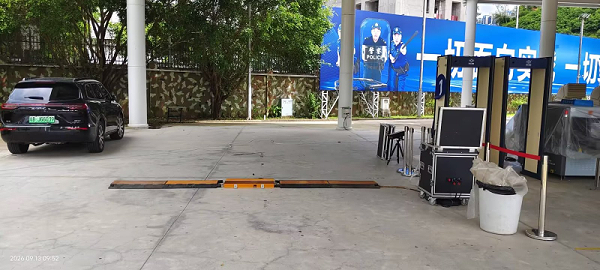
A surface-mounted UVSS deck at a facility entrance: no excavation, screening from day one.
The use cases follow the threat, not the industry. Border crossings and ports of entry screen every vehicle for concealment routes. Airports screen service vehicles entering airside perimeters. Prisons and detention centres check every vehicle that passes the gatehouse, because a car underside is the classic smuggling route in and out. Data centres, power stations, military compounds and government sites treat the undercarriage check as a standard access-control layer. And temporary deployments - summits, sporting events, disaster response - rely on mobile decks that screen a location that will never justify concrete. Seenboom's project pages for border installations and temporary event screening show what each of these looks like in practice.
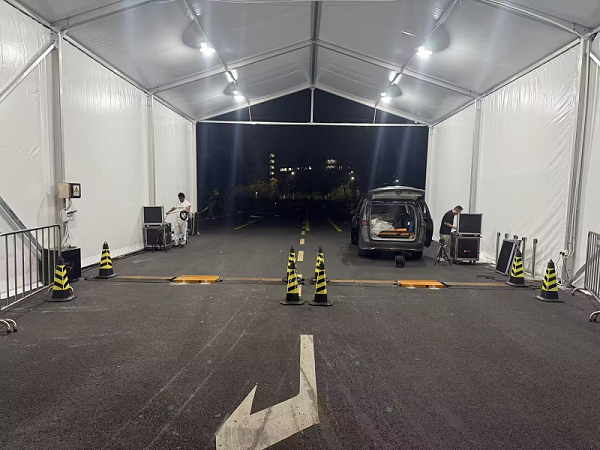
A mobile UVSS screening vehicles inside a temporary checkpoint tent.
02 Key Buying Criteria: What Actually Decides Performance
Specification sheets list dozens of parameters. Six of them decide whether a system works at your site, and they are worth reading in this order.
Imaging method. Ask for a distortion-free, area-array image of the full vehicle width, captured in one pass, and ask to see a real scan - not a marketing render - at the resolution being quoted. A usable image lets a reviewer read a bolt head and tell a factory bracket from one welded on last month. If the centre of the image is stretched and the edges compressed, that resolution exists only on paper; what a high-resolution, distortion-free undercarriage image looks like is the benchmark to hold every demo against.
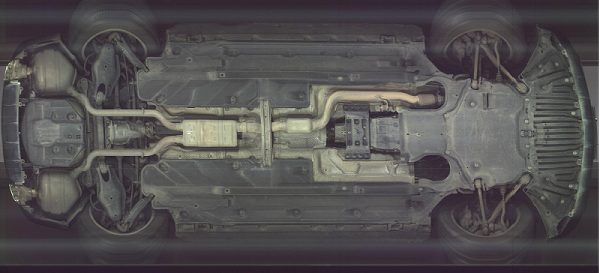
A full-width, distortion-free undercarriage scan: every region of the chassis at consistent scale.
UV-resistant, weatherproof construction. An outdoor scanner deck is a piece of street furniture that sits in the sun for a decade. Ultraviolet radiation yellows and embrittles polycarbonate windows, degrades seals and fades housings long before electronics fail, so the enclosure material grade, the UV test the supplier can evidence, and the warranty that covers the housing itself are buying criteria - not footnotes. Pair this with the ingress rating: IP68 is a test, not an adjective, and it should be quoted together with the operating temperature range your site actually reaches.
AI alerting. The imaging half of the problem is solved; the review half is not, and that is where AI earns its place. A useful system aligns each scan against a stored baseline for that chassis type, and where a plate number is available, against the vehicle's own earlier passes, then hands the officer a short list of marked regions with confidence scores. What separates a serious implementation from a red-box demo is behaviour under bad conditions: a muddy chassis in heavy rain should produce a low-confidence result that escalates to manual inspection, not a clean pass. Ask to see exactly that at the demo.
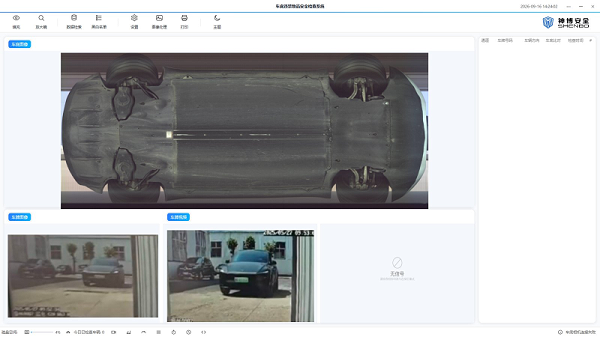
The operator workstation: full chassis scan on the left, AI-marked regions and vehicle record on the right.
ANPR and platform integration. A detection that stays on its own monitor changes nothing. The plate read and the scan must refer to the same vehicle event, and that event must be able to reach the barrier controller, the video management system and the site's security platform through a documented, push-capable API. How AI and ANPR integrate into under-vehicle inspection workflows is worth reading before you accept the phrase 'we have an API' at face value.
Load rating and installation footprint. Match the deck to the heaviest axle that will ever cross it, not the average vehicle: fuel tankers, refuse trucks and armoured carriers each impose their own number. Seenboom's heavy-duty fixed platform is rated above 70 tonnes and the general-purpose unit at 50 tonnes. Then count the civil works honestly - a buried deck needs excavation, drainage and a lane closure; a surface-mounted or portable unit needs a firm, level surface and one cable run.
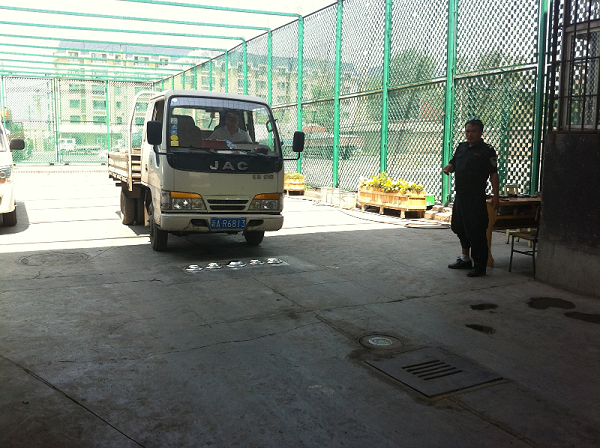
A truck passing over a fixed UVSS deck at a facility gate - the scan completes without the vehicle stopping.
03 Market and Budget: Reading the Price, Not Just the Number
The US under vehicle surveillance market has traits a buyer should understand before comparing quotations. Procurement usually runs through tenders or integrators rather than direct retail, which means the vendor you evaluate may not be the company your integrator resells - check who holds the software source, who carries the warranty and who ships spare parts. Federal and state projects add a compliance layer: buyers on US government-funded work increasingly require component-provenance documentation, and any supplier should be able to state where its cameras, network modules and compute platforms come from. Data-retention and privacy expectations are set locally, so confirm the system supports your retention policy rather than a fixed one.
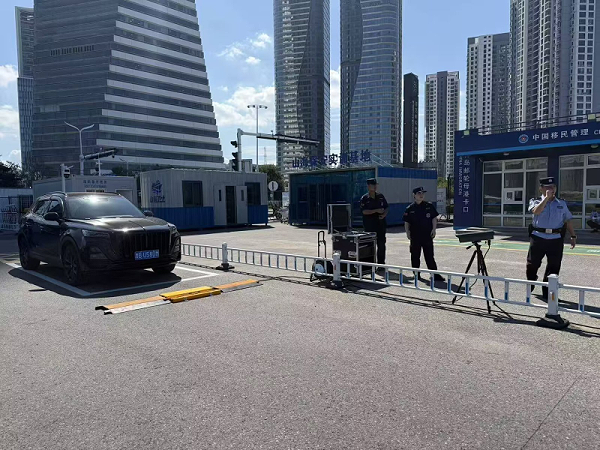
A checkpoint deployment in an urban environment - the configuration, not the catalogue, decides the budget.
On budget, the discipline that matters is total cost of ownership. Hardware is one line among six: civil works and installation, commissioning and training, spares, annual maintenance, and software licences or subscriptions. A portable deck that is struck and redeployed weekly wears on a different schedule than a buried deck that runs untouched for years, and the crossover between the two cost profiles lands somewhere between eighteen months and three years of continuous operation - the detailed arithmetic is in the UVSS price guide.
That is also the right place to talk about how prices should be shown. Too many quotations are a single number with an annex. A serious supplier's price display works the way a configurator does: hardware priced by configuration tier - with the UV-resistant enclosure grade, camera resolution and lighting class each listed as their own line - followed by civil works, commissioning, maintenance and software shown separately. Buyers searching for a 'UV resistant vehicle price display' are, in practice, looking for exactly this: a quotation where the weatherproofing and configuration options sit next to the money instead of buried in fine print, so two offers can be compared line by line. When one quote is dramatically lower than the rest, the difference is almost always in the lines that were not displayed: lighting grade, enclosure material, software modules, training hours, or the warranty's small print.
04 Vendor and Compliance Checklist
Integrators shortlisting suppliers can work down this list. Every item should be answerable in writing within a day or two; hesitation on the basics is itself an answer.
- Certifications and test evidence: CE or FCC as the destination market requires, ISO 9001 for the factory, IP68 and load test reports for the deck, and UV-ageing evidence for the enclosure.
- Reference projects in your sector: at least two installations with traffic and environment similar to yours, with names you may contact. Seenboom's UVSS case studies cover airports, borders, prisons and government sites.
- Site survey: the vendor should offer a remote or on-site survey covering lane geometry, drainage, power and network before quoting - a quotation issued without one is an estimate, not a price.
- Delivery and lead time: a written lead time for the standard configuration and for spares, with the shipping terms stated.
- Service and SLA: response time, remote diagnostics capability, spare-parts stocking policy and the training package included in the price.
- API and documentation: a documented event API, sample payloads, and the integration references for the VMS or access-control platform your site already runs. The supplier checklist expands each of these twelve points before you buy.
05 Common Pitfalls
Three mistakes account for most UVSS disappointments, and all three are avoidable at specification stage.
Believing pixel count equals image quality. A high sensor resolution behind cheap optics, weak lighting or aggressive stitching produces a sharp photograph of nothing useful. Judge the image, not the number: demand real scans from a live lane, in daylight and at night, and check whether details stay readable across the full vehicle width.
Ignoring outdoor UV ageing. Buyers test the electronics and forget the housing is the part that lives in the sun. An enclosure that yellows within two seasons diffuses the lighting, degrades the image and voids nobody's warranty gracefully. Specify the UV-resistant material grade and make the housing warranty explicit - it is one of the few lines in a quotation that predicts what the system looks like in year five.
Assuming the system works out of the box. A UVSS that is not integrated into the checkpoint's workflow - barrier, ANPR, VMS, visitor system - becomes a second screen nobody watches by month three. Integration is not an option to add later; it is the specification. Insist on a documented API and a commissioning scope that ends with the scan integrated into your existing security checkpoint solutions, with operators trained on the combined workflow rather than the scanner alone.
06 Quick RFQ Template
A one-page enquiry that contains the following ten items will get you a firm, comparable quotation instead of a brochure:
- Site type and location (border crossing, airport, prison, facility gate, temporary deployment).
- Traffic: vehicles per day, peak-hour volume, and the hours the lane is staffed.
- Vehicle mix: passenger cars, trucks, tankers, armoured vehicles - heaviest axle expected.
- Platform preference or constraint: fixed buried, surface-mounted, or portable.
- Lane details: width, gradient, drainage situation, available power and network at the lane.
- Environment: temperature range, UV exposure, dust, flooding, corrosive coastal air.
- Integration targets: ANPR, barrier control, VMS or PSIM platform, existing credentials systems.
- Compliance requirements: certifications, data-retention policy, component provenance where applicable.
- Budget range and procurement route (direct purchase, tender, integrator-led).
- Timeline: required on-site date and any phased deployment plan.
07 FAQ
What IP rating should a UVSS have?
For an outdoor scanner deck, IP68 is the sensible specification: dust-tight, and tested for continuous immersion under conditions the manufacturer states. The rating only means something with the test report behind it, so ask for the certificate, not just the two letters. Buried decks also need drainage designed into the pit, because the ingress rating protects the deck but standing water in the pit still degrades images and shortens the life of everything around it.
How often do AI anomaly alerts turn out to be false alarms?
A well-configured system marks a small number of regions per shift, most of which are benign changes - a tow bar, a mud shelf, an after-market bracket. That is the intended behaviour: the AI narrows the review to a short list, and the officer confirms. False-alarm rates climb when the baseline is generic instead of built from your own vehicle mix, and when the system returns confident results on poor images. Both are configuration questions, so before purchase, ask the vendor to demonstrate the baseline-building process and the low-confidence behaviour with a deliberately dirty vehicle.
Will a UVSS integrate with our existing security checkpoint solutions?
Almost always, provided integration is specified rather than assumed. The unit of exchange is an event - image reference, plate string, lane identifier, timestamp, decision - pushed through a documented API to the barrier controller, the VMS and the security platform. What varies between vendors is the quality of that interface: whether events push or must be polled, whether the API is versioned and documented, and whether the supplier has reference integrations with the platforms you already run. Put all three questions in the RFQ.
How long does deployment take?
A portable deck screens vehicles the day it arrives. A surface-mounted deck typically needs days, not weeks. A buried fixed deck needs excavation, drainage and concrete curing, so plan for several weeks of civil works and a lane closure - the hardware lead time runs in parallel, not after. The civil scope is why an honest site survey belongs before the quotation, not after the purchase order.
08 Conclusion
The selection logic compresses to four steps. Define the scene - permanent lane, surge capacity or temporary deployment - because that chooses the platform. Set the imaging and environmental requirements in writing: distortion-free full-width imaging, a UV-resistant enclosure with the test evidence behind it, the load rating your heaviest vehicle demands. Read the quotation as a tiered price display rather than a number, comparing hardware, civil works, maintenance and software line by line. Then verify the vendor the way you would verify any long-term infrastructure partner: certificates, reference projects, a real site survey and a documented API.
Seenboom has built under vehicle scanning systems for borders, airports, prisons and government facilities since 2000, in fixed, surface-mounted and portable configurations, and will quote any of them against a site drawing and a week of traffic counts. Send both to zhangxiaohui@seenboom.com or message WhatsApp +86 183 6310 1063, and you will receive back a configuration, an itemised quotation, and the civil works scope if the answer is a fixed lane - or an honest recommendation that you do not need one.


