

UVSS for Border Crossing and Customs: Optimise Cargo Screening Throughput While Beating Smuggling Risks | SEENBOOM
A land border never closes. Freight queues build up at dawn, temperature swings from desert heat to mountain frost, and every truck in the lane has to be inspected without becoming the reason the queue doubles. At the same time, undercarriage smuggling remains one of the cheapest and most common concealment methods on overland routes. This guide sets out what a border checkpoint actually needs from an under vehicle surveillance system - and how to design the lane so cargo screening throughput and inspection strength rise together instead of trading off.
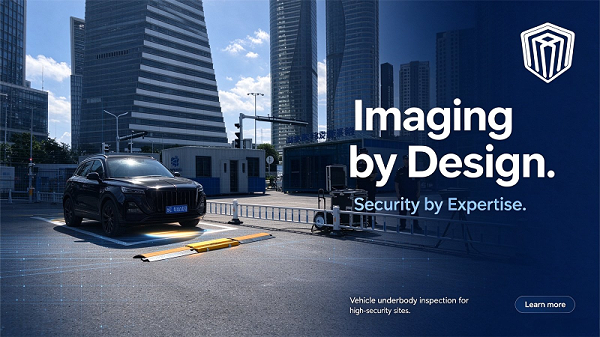
A drive-through under vehicle scanning lane at a border checkpoint - freight passes in motion while the chassis panorama is captured in one clean sweep.
01 The Reality at a Border Crossing
Border traffic is unlike any other checkpoint duty. A national events venue screens VIP sedans twice a day; a customs post may push two thousand vehicles through in twenty-four hours, most of them loaded trucks with long wheelbases, dual rear axles and aftermarket underbody fittings. Any inspection step that forces the driver to stop, align or dismount becomes the bottleneck of the whole crossing, so border security teams judge vehicle screening equipment by one number first: vehicles per hour without a queue growing behind the barrier.
The environment is equally unforgiving. Coastal and estuary crossings run in salt fog that corrodes exposed connectors within months; desert corridors carry blowing sand and 60-degree surface temperatures; high-altitude passes add freeze-thaw cycles and ice meltwater standing in the lane. A deck that survives an urban car park will not necessarily survive a border winter.
And there is a third constraint unique to customs: the data cannot leave the site. Inspection records at a border checkpoint are classified evidence. Any platform that pushes chassis images to an external cloud, an overseas server or a vendor account is a non-starter - the system has to store, compare and archive everything locally, under national security supervision.
02 Core Requirements for a Border Customs UVSS
IP68 protection is the baseline, not a feature. In a customs lane the scanning units sit below road level in standing water, mud, sand and de-icing salt for years. Sealed IP68 decks with no exposed cabling, plus heating and drainage designed into the enclosure, are what separate a system that runs for a decade from one that fails in its second monsoon. Seenboom's fixed decks are built to this standard - the buried or surface-mounted design leaves nothing above the pavement to be clipped by a trailer or washed out by flood water.
Load rating must match the fleet. Loaded cargo trucks, fuel tankers and buses put point loads far beyond a passenger-car rating on the deck edge and the ramp. A border lane needs industrial load class, anti-slip surface, and a chassis geometry that reads long wheelbases and lifted suspensions as cleanly as it reads a sedan.
Offline local storage is a hard requirement. Chassis images, ANPR records and alarm annotations must remain inside the customs network. A serious under vehicle surveillance system for border use runs entirely on a local server - including the AI baseline comparison - and exports evidence only on authorised request. Seenboom offers fully air-gapped offline editions on Linux and Kylin precisely for projects of this classification.
ANPR integration closes the loop. Plate recognition ties each chassis scan to the vehicle, the driver's declaration and the customs entry file, so an anomaly alarm becomes an actionable inspection instruction instead of a loose image. Open API access to the site's VMS and customs management platform matters here - proprietary lock-in is a real risk on a national project.
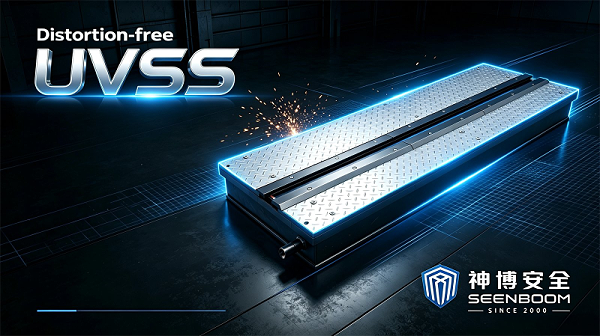
An IP68-sealed, heavy-duty scanning deck built into the pavement - engineered for salt fog, sand load and the point loads of loaded freight trucks.
03 Deployment Essentials: Lane Design, Speed and Workflow
Lane geometry decides throughput before any camera does. A dedicated freight lane with a straight, level approach lets drivers cross at a steady low speed without alignment coaching; mixed lanes with tight turning radii produce angled crossings and re-scans. Ramps and approach angles should be sized for the lowest-clearance vehicle expected on the route, and the scanning zone must be long enough that image capture completes within the pass - not dependent on the driver pausing in exactly the right spot.
Pass-through speed and image quality have to be specified together, not traded quietly. A quality system keeps true-to-scale stitching across the whole stated speed window, so officers can raise the target speed during peak hours without degrading evidence. Ask any supplier for sample scans captured at your lane's real speed with a loaded truck - not a demo sedan on an empty deck.
Workflow integration is where throughput is actually won. The strongest pattern is two-tier screening: the UVSS clears the ordinary traffic automatically on every pass, while ANPR, risk profiling or the AI baseline comparison escalates only suspect vehicles to the physical customs inspection bay. Smuggling detection then concentrates officer time where it matters - the undercarriage panorama, the plate record and the alarm region arrive at the inspection desk as one linked evidence package. A checkpoint that inspects every vehicle by hand is not more secure; it is simply slower.
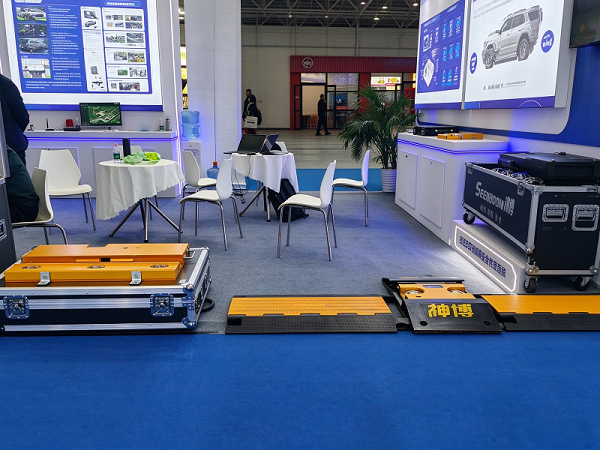
Flight-case portable decks extend the same screening standard to temporary crossings, mobile patrol checkpoints and incident-response lanes.
04 Fit for the Market: Central Asia and Middle East Border Projects
Central Asian crossings combine extreme temperature ranges, long freight corridors and multilingual plates, so ANPR tuned only for Latin characters fails quietly. Projects in this region need multi-script plate recognition, cold-start heating inside the deck, and offline operation across networks that cannot be assumed stable. Dust sealing and remote diagnostics matter just as much - a crossing four hours from the nearest service city cannot depend on weekly site visits.
Middle Eastern border posts bring salt-laden coastal air, sand ingress and sustained high pavement temperatures. IP68 decks with convection cooling and sand-tight sealing have run through full summer cycles there; load ratings are sized for the region's heavy truck fleets, and the offline storage requirement is absolute. In both markets, the buyers who evaluate an under vehicle surveillance system price properly ask for the lifecycle cost - the deck that survives the climate is almost always cheaper over five years than the cheapest bid.
Seenboom has been developing under-vehicle imaging since 2000, contributed to the 2014 industry standard, and delivers fixed and portable lanes to government, customs and infrastructure projects across these regions - with sample scans, offline editions and integration references available on request. The border customs solution overview on seenboom.com walks through a reference deployment lane by lane.
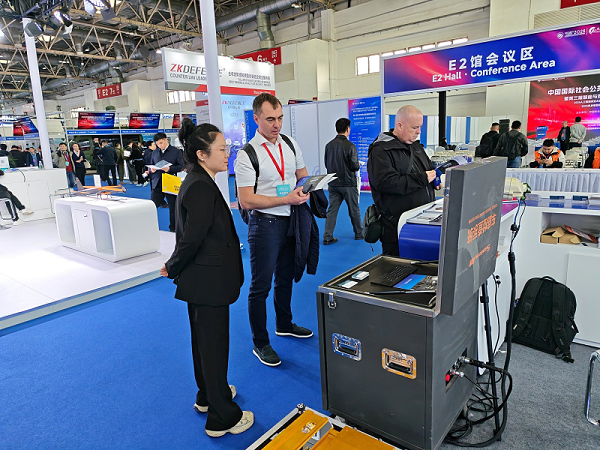
An international delegation reviews a portable screening kit at Seenboom's exhibition booth - the same imaging chain specified for permanent border lanes.
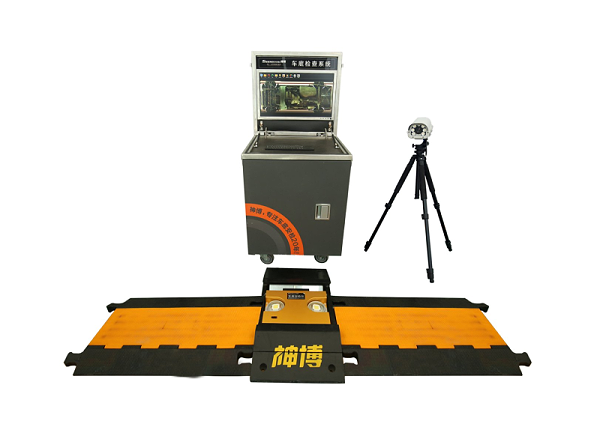
A portable UVSS control kit with ANPR workstation - rapid deployment where a permanent lane is not yet built.
05 Bottom Line: Throughput and Security Can Rise Together
A border crossing does not have to choose between moving traffic and catching concealment. The combination that works is proven: an IP68, heavy-rated scanning lane that captures during the drive-through, local offline storage that satisfies national security supervision, ANPR that links every scan to a plate and a declaration, and AI baseline comparison that escalates only genuine anomalies to manual inspection.
If you are planning or upgrading a border checkpoint, start with three documents: your lane drawings, your vehicle mix at peak hour, and your data-residency rules. Seenboom will return a matching proposal, sample scans at your lane speed, and a live online demonstration of the comparison workstation. Contact zhangxiaohui@seenboom.com or WhatsApp +86 183 6310 1063.


