

From booth 2B26 at Messe Essen our team spent the opening day meeting long-standing partners and new prospects face to face, running live demonstrations of the SEENBOOM UVSS under-vehicle scanning system, and listening to the site security problems European customers are actually trying to solve. If you are at the show, the team is at booth 2B26 through Friday 25 September. If you are not, this is the opening-day report: what we are showing, how the imaging works, and what the first day of conversations told us about this market.
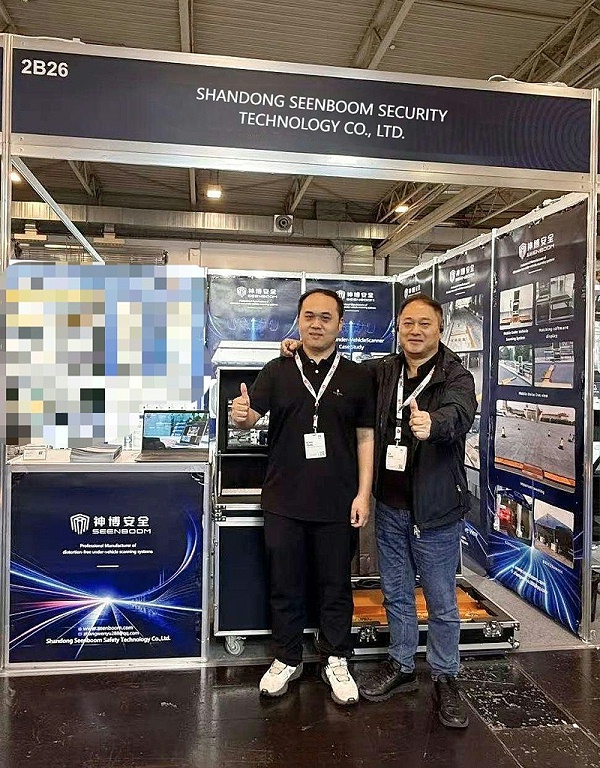
Seenboom at booth 2B26, Security Essen 2026, opening day, 22 September 2026. Photo: Seenboom.
Security Essen 2026 at a Glance
Security Essen is one of the reference trade fairs of the international security industry, and the 2026 edition runs from 22 to 25 September at Messe Essen, Messeplatz 1, 45131 Essen, Germany. Doors are open 9 a.m. to 6 p.m. Tuesday to Thursday and 9 a.m. to 4 p.m. on Friday. Two features make this edition worth a visit on their own: the exhibition covers the whole span of physical and electronic security, from armoured vehicles and civil protection to access control, video surveillance, perimeter security, fire protection and cybersecurity, which means a vehicle screening conversation can be held with people who own the entire perimeter rather than only the gate; and for the first time the Euro Defence Expo (EUDEX) is running concurrently at the same venue, adding a defence audience alongside the civil one. Dates, halls and visitor information are published on the official fair site and on the EUDEX pages.
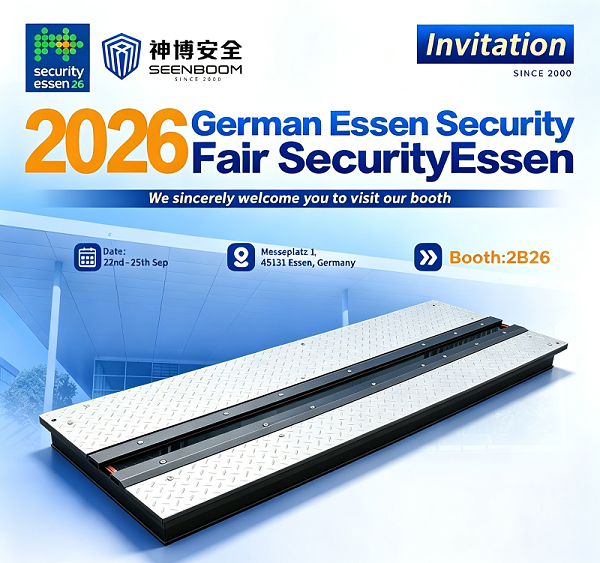
Security Essen 2026 runs 22-25 September at Messe Essen; Seenboom exhibits at booth 2B26.
What We Are Showing at Booth 2B26
Three solutions are on the stand, and between them they cover the three ways a site normally has to add under vehicle inspection to a gate.
Fixed under-vehicle scanning. The deck is set flush into the lane so the vehicle drives over it at normal approach speed and the underside is captured in a single pass, with no stop, no lift and nobody underneath. This is the configuration specified for permanent gates, and the fixed under-vehicle inspection system shown in Essen is sealed to IP68 and carries a load rating above 70 tonnes, with a watertight compartment structure borrowed from marine practice.
Mobile under-vehicle scanning. Where a gate cannot be dug up, or screening is needed only for a period, the same imaging chain travels in a portable case with its own deck. The mobile under-vehicle scanner is what most visitors stop to handle first, because it answers a very common project constraint: a site that has to be screening vehicles next month without a construction programme.
AI-assisted image analysis. The third element is the software layer. Multi-lens imaging hardware feeds an analysis stage that flags foreign objects on the underside and marks them on screen, so the operator reviews exceptions instead of studying every image from scratch.
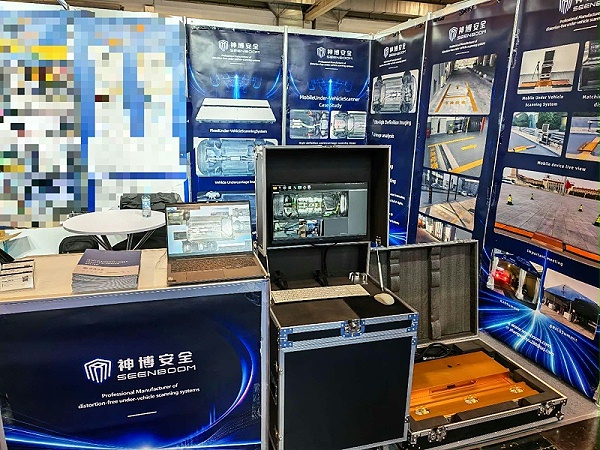
The mobile under-vehicle scanner, live imaging workstation and reference decks at booth 2B26.
Inside the Imaging Chain
The question a security engineer asks about any drive-over image is whether it can be trusted twice: once on the screen, and once six months later when a comparison has to be made. Three properties decide that.
First, capture geometry. The system uses area wide scanning with simultaneous exposure across the full track width, so the whole underside is recorded in one instant rather than assembled while the vehicle is still moving over the sensor. The practical difference appears the moment a driver brakes or accelerates on the deck: in a sequential capture that movement changes the geometry of the image and stretches it, while a simultaneous exposure is unaffected. This is the reason area wide scanning replaced earlier capture methods in our current generation, and why the resulting image of a distortion-free under-vehicle scanner can be measured rather than only looked at.
Second, stitching and resolution. Multiple lenses cover the full width of the lane and their frames are stitched in real time into one continuous view at 5K-class resolution, which is the level at which a clip, a fastener or a thin wire remains distinguishable. Resolution is not a marketing number at a checkpoint; it is the difference between seeing an object and identifying it.
Third, what happens after capture. Images are stored against the vehicle so that a later comparison is possible, and the analysis stage applies automatic object detection to highlight anything that does not belong. Retention closes the loop: an image that cannot be produced afterwards has limited value in a dispute or an incident review, which is why the platform keeps the capture tied to a vehicle identifier and a timestamp rather than leaving it on a live screen. Taken together, the three properties are what turn a photograph into evidence. The same principles are described in more detail in our guide to security checkpoint solutions for vehicle screening.
Why These Systems Are Trusted at National Level
A trade fair is a reasonable place to ask a supplier what its equipment has actually been relied on for. Seenboom has worked in under-vehicle security inspection since 2000 and is registered as a national industry standard drafting unit; in 2014 the company took part in drafting the industry standard for under-vehicle security inspection systems, which is the framework Chinese operators design their checkpoints against today. The company profile and the development history set out the whole record.
The reference list is the more concrete part of it. Seenboom was the designated supplier of under-vehicle security inspection and scanning systems for the Beijing Olympics in 2008, held the same role for the Shanghai World Expo in 2010, and has provided under-vehicle inspection technical support for national inspection stations under the Belt and Road Initiative since 2017. From 2021 the company supported vehicle under-vehicle inspection for the National Two Sessions for six consecutive years. On the engineering side it holds more than 40 independent intellectual property patents, with a further 20-plus applications in progress and over 30 software copyrights, and has received four military science and technology progress awards. None of that substitutes for a live demonstration, which is precisely why the equipment is on the stand rather than in a brochure.
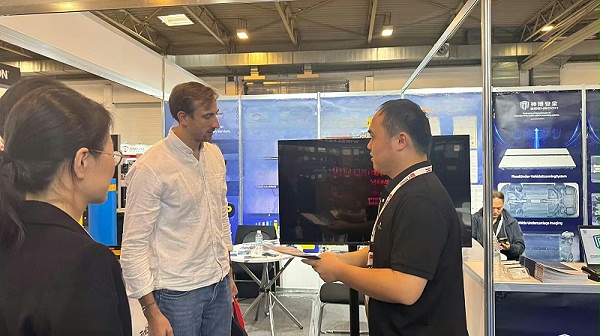
Live under-vehicle imaging on the booth display during a Day 1 discussion with a European visitor.
Specifications You Can Check on the Stand
The numbers a project team will want to verify are visible on the stand rather than quoted from memory. The fixed decks shown in Essen are sealed to IP68 and rated to withstand vehicles above 50 tonnes, with a watertight compartment construction that keeps water out of the electronics through standing water and repeated wash-down. The distortion-free fixed unit carries a rating up to 50 tonnes and captures at 5K resolution. Maintenance is the other point that comes up repeatedly, and the answer is deliberate: a deck that can be washed down and a cabinet that opens without breaking a seal are what keep a lane available over years rather than months. For a project that has to justify its choice to a client, the exhibition is also the place to ask the awkward questions: what happens under continuous rain, how the image is retained, and what the software does with a detection.
What the First Day Told Us About This Market
Day 1 produced a clear picture of what European buyers are solving for, and it differs in emphasis from other regions we work in.
Retrofit dominates. A large share of the enquiries were about existing gates where the civil works, not the budget, are the real obstacle: a lane that cannot be closed for a month, a listed building, a site with services under the roadway. The mobile configuration and the shallow fixed deck both exist for that conversation.
Climate is a specification item, not an afterthought. Northern European sites raise winter operation, salt and spray, and drainage; southern and alpine projects raise heat, dust and altitude. Buyers here expect those conditions to be discussed as engineering rather than as warranty exceptions.
Integration matters as much as detection. The recurring requirement is that the image and the result should arrive in the customer's own system, tied to a vehicle record, instead of sitting on a standalone screen. That is a software and interface question, and it is worth bringing to a meeting rather than resolving them by email after the order.
Operator workload, finally, is raised more often here than in any other market we exhibit in. Sites that already run a dozen cameras are careful about adding another screen, and what interested visitors on the stand was not more images but fewer decisions per vehicle. That is exactly what automatic object flagging is for, and it is the part of the demonstration that generated the longest conversations.
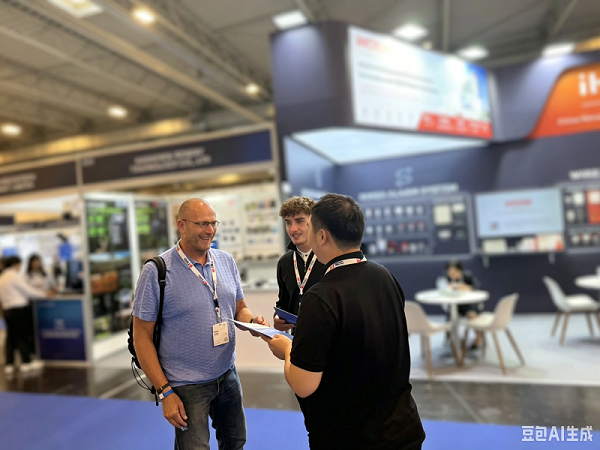
Live under-vehicle imaging on the booth display during a Day 1 discussion with a European visitor.
Visit Us Before Friday, or Reach Us Afterwards
The team is at booth 2B26 until the fair closes on Friday 25 September, and a walk-up conversation is enough. Bring the site layout if you have one: the useful part of a first meeting is usually the lane, the vehicle classes and the conditions the installation has to survive.
If you cannot make it to Essen, the same conversation works remotely. Open a chat with a Seenboom sales engineer, email zhangxiaohui@seenboom.com, or use the contact page. Configurations already delivered across industries are catalogued in the custom solutions section, and the fixed and mobile ranges are listed under the fixed and mobile series. A closing report from the show, with the outcomes of the week and the questions that came up most often, will follow after the fair.
Independent background on the sector is published by the official fair organiser, the British Security Industry Association and CISA for critical infrastructure protection.


